The Forging of England: The Epic Journey of the Angles, Saxons, and Jutes
For centuries, the identity of the English people has been viewed as a rich historical tapestry. When we look at modern England, it is easy to see a single unified country with a globally dominant language. However, beneath the surface lies a dramatic, centuries-long story of displacement, climatic upheaval, structural adaptation, and cultural fusion.
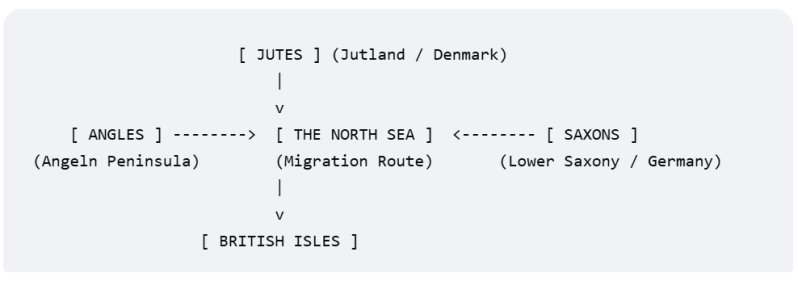
The foundations of the English nation were not native to the British Isles. Instead, they crossed the volatile waves of the North Sea during the 5th century. Driven by climate shifts and political opportunities, three distinct Germanic tribes—the Angles, the Saxons, and the Jutes—reshaped a Celtic-Roman island into a completely new land: Englaland.
1. The Continental Homelands: Who Were They?
Long before they set foot on British shores, these Germanic groups inhabited the densely forested, low-lying coastal regions of northern Europe.
The Angles (The Namesakes)
The Angles originated from Angeln, a small, hook-shaped peninsula bridging modern-day northern Germany and southern Denmark. The medieval Danish historian Saxo Grammaticus recorded that Angle was the legendary progenitor of the tribe. In their native tongue, their homeland was called Angland. It is from this specific tribe that the words England and English are derived.
The Saxons (The Builders of the South)
Hailing from the vast, marshy lowlands of Lower Saxony (modern northwestern Germany and parts of the Netherlands), the Saxons were infamous across the Roman world. Roman writers frequently documented them not just as farmers, but as exceptionally fierce maritime raiders who harassed the northern coastlines of the Roman Empire.
The Jutes (The Southeastern Vanguard)
The Jutes migrated from the northern reaches of the Jutland peninsula in modern Denmark. While smaller in overall numbers compared to the massive waves of Angles and Saxons, the Jutes played an invaluable role as the initial political and military vanguard of the migration.
2. The Migration and Kingdoms
The incoming waves of continental tribes split across specific geographical zones, shifting the indigenous Celtic populations and creating distinct cultural identities.
The historical map illustrates the large-scale 5th-century migration where the Angles, Saxons, and Jutes sailed across the North Sea from modern-day Germany and Denmark to settle in Britain. As these incoming continental waves established distinct territorial strongholds, they permanently altered the island's demographics by pushing the indigenous Celtic Britons to the western and northern fringes, including Wales, Cornwall, and Scotland. Over time, this regional division paved the way for the Heptarchy, a network of seven unique Germanic kingdoms that gradually fused their tribal traditions, legal frameworks, and dialects to form the initial structural identity of England. [1, 2, 3]
3. The 5th-Century Migration: Push and Pull Factors
Why did entire tribal societies uproot their families, cattle, and belongings to sail across dangerous, unmapped waters? History and modern science point to two major factors:
- The Push (Climate Collapse): During the 4th and 5th centuries, the Northern Hemisphere experienced a prolonged cooling period. The low-lying regions of northern Germany and the Netherlands faced severe, catastrophic flooding. With failing crop yields and vanishing land, migration became a brutal necessity for survival.
- The Pull (The Ghost of Rome): By 410 AD, the Roman Empire was fracturing. Rome withdrew its last legions from Britain, leaving the indigenous Celtic Britons wealthy but completely undefended against raids from the northern Picts and Scots.
According to the 8th-century monk and historian Venerable Bede, a British chieftain named Vortigern took a desperate gamble. He hired two Jute mercenary brothers, Hengist and Horsa, offering them fertile land in exchange for military protection. The mercenaries quickly realized their employers were weak and the land was rich. They sent word back across the North Sea: Britain is ripe for the taking.
4. The Heptarchy: Mapping the Anglo-Saxon Kingdoms
As the Germanic tribes flooded into Britain, they didn't just replace the native population; they fundamentally altered the landscape. While the native Celtic Britons were pushed into the rugged western fringes (modern Wales, Cornwall, and Strathclyde), the newcomers divided the fertile lowlands.
By the year 800 AD, these tribal territories had consolidated into seven prominent kingdoms, known historically as the Heptarchy:
- Kent (Jutes): Settled in the extreme southeast; became the crucial early gateway for Christianity and the home of Canterbury.
- Wessex (Saxons): Established in southwest England; evolved into the ultimate military shield against Viking invasions.
- Sussex (Saxons): Settled along the southern coast by the warrior leader Ella.
- Essex (Saxons): Located on the eastern coast; held vital defensive positions surrounding early London.
- Mercia (Angles): Formed in the Midlands; grew into a dominant, powerhouse military territory.
- Northumbria (Angles): Established in northern England; became the legendary intellectual center during the golden age of learning.
- East Anglia (Angles): Settled on the eastern peninsula; divided naturally into the "North Folk" (Norfolk) and "South Folk" (Suffolk).
5. A Short Chronological History of England
The transformation from an unmapped cluster of tribal warlords into a single, unified kingdom of England occurred in three defining historical eras:
📊 Chronological Evolution Timeline
Era 1: The Cross and the Quill (6th–8th Century)
The early Anglo-Saxon settlers were staunch pagans, worshiping Germanic gods like Woden and Thunor. This changed fundamentally in 597 AD when Saint Augustine was dispatched by the Pope to Kent.
The conversion of the Anglo-Saxon kings brought literacy, the Roman alphabet, and massive advancements in art and legal structures. Monasteries flourished, producing masterworks like the Ecclesiastical History of the English People by Bede and preserving oral epics like Beowulf.
Era 2: The Fury of the Northmen and Unification (793–1066 AD)
In 793 AD, a terrifying new force struck the holy island monastery of Lindisfarne: the Vikings. Over the next century, Scandinavian armies systematically conquered Northumbria, East Anglia, and Mercia.
Only the kingdom of Wessex held out under the brilliant leadership of King Alfred the Great. Alfred stabilized the front lines, negotiated the Danelaw boundary, and initiated a massive English cultural and literacy revival.
The dream of a unified nation was fully realized by Alfred’s grandson, King Æthelstan. In 927 AD, after capturing York from the Vikings and securing submissions from Scottish and Welsh rulers, Æthelstan officially took the title of Rex Anglorum—the first true King of England.
Era 3: The End of an Era (1066 AD)
The Anglo-Saxon experiment came to a crashing, violent halt at the Battle of Hastings in October 1066. William, Duke of Normandy, launched a successful invasion from France, defeating and killing Harold Godwinson, the last Anglo-Saxon king of England.
The Normans systematically replaced the entire Anglo-Saxon ruling class with French-speaking lords. While this brought an end to Anglo-Saxon political rule, the core identity, field systems, town names, and genetic makeup of the English people remained fundamentally tied to those original 5th-century travelers.
6. The Living Linguistic Legacy
Perhaps the most enduring monument to the Angles, Saxons, and Jutes is the language you are reading right now. Old English was a purely Germanic language. Even though French and Latin vocabulary flooded the language after the Norman Conquest of 1066, the foundational skeleton of English remains thoroughly Anglo-Saxon.
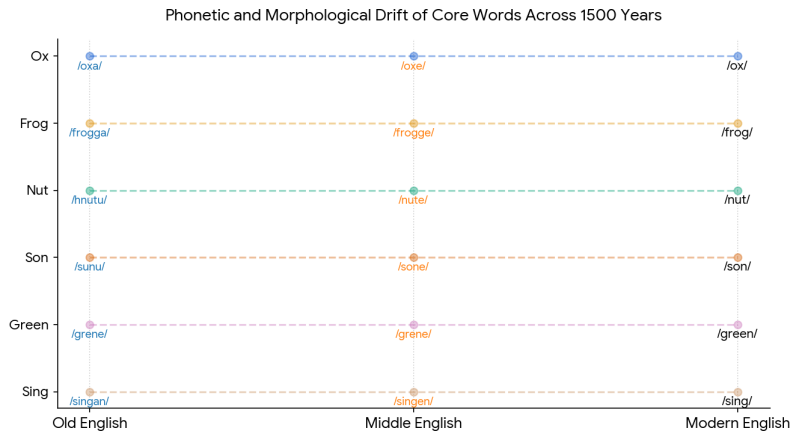
📈 Phonetic and Morphological Word Drift Across 1,500 Years
You can track how little the core vocabulary of daily life has shifted structurally from Old to Middle, and finally to Modern English.
When you look at modern English maps, the suffix -sex refers to Saxon territories (Essex, Sussex), -ham means home or village, and -ing denotes "the people of". The tribal borders of the 5th century are still written into the geography of modern Europe.
Watch the documentary about the origins of the English language By TedEd, and an excerpt from a film Beowulf (2007). Beowulf is an anonymous Old English epic poem that preserves the heroic legends and tribal history of early medieval Germanic peoples.
Beowulf Reading on LibriVox - click here for the audio.
Add comment
Comments