
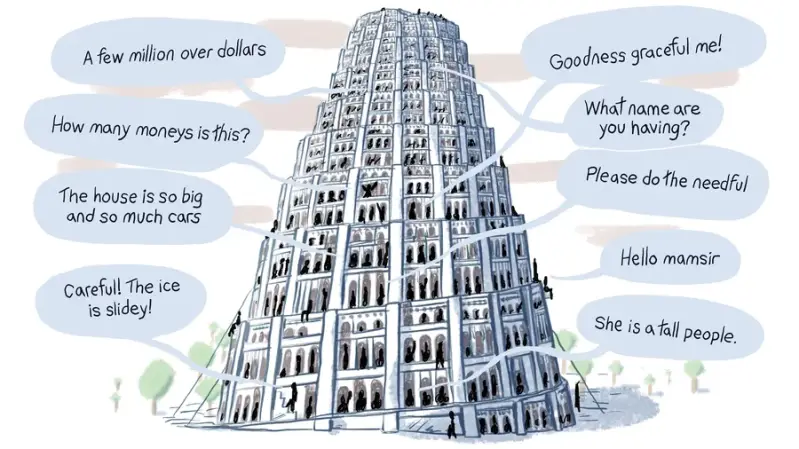
Euro English: Does Your Accent Really Matter?
Do you speak English with a French, German, Spanish, Polish, Serbian or Scandinavian accent? That's perfectly fine.
Across Europe, English is increasingly used between people who speak different first languages. A German may work with a Spaniard, a Serbian with a Swede, or a French designer with a Polish developer.
This is English as a Lingua Franca (ELF) — and it has contributed to what is often called Euro English: English adapted by Europeans for international communication.
It isn't simply "bad English". It reflects Europe's linguistic and cultural diversity.
🗣️ Accent isn't the same as ability
You don't need to sound British or American to speak excellent English.
Accent ≠ intelligibility.
A strong accent can be easy to understand, while someone with a "native-like" accent can be difficult to follow if they speak too quickly or mumble.
For international communication, focus on:
-
🔊 clear sounds
-
🎵 word and sentence stress
-
⏸️ natural pauses
-
🐢 manageable speed
-
🔚 clear word endings
Your goal isn't "Nobody should know where I'm from."
It's:
"People should understand me easily."
🎭 Your accent gives your English character
An accent is part of your linguistic identity. French rhythm, Spanish pronunciation, Slavic consonants or Scandinavian intonation can all leave traces in English.
There is no need to erase them.
What matters is making your speech clear and flexible enough for international listeners.
🌍 English is also a cultural language
Speaking English internationally means navigating more than vocabulary and grammar. People bring different expectations about:
-
🤝 politeness and directness
-
👔 workplace behaviour
-
😂 humour
-
⏰ punctuality
-
💬 how openly to disagree
A German speaker may sound direct; a British speaker may soften disagreement; a Spanish speaker may use a more expressive conversational style; Scandinavian workplaces may be relatively informal and egalitarian.
These are tendencies, not rules. The important skill is cultural flexibility — knowing when to adapt your communication to your audience.
Common pronunciation challenges
Different first languages create different obstacles.
🇩🇪 German speakers
-
🔤 W/V: wine / vine
-
👅 TH: think, three, this
-
🔚 consonant endings
-
🎵 English stress and rhythm
German speakers also benefit from the close historical relationship between German and English.
🇫🇷 French speakers
-
👅 TH: think / this
-
🔊 H: air / hair
-
🗣️ vowel contrasts: ship / sheep
-
🔚 final consonants and clusters
French speakers may sometimes favour elaborate formulations. In international communication, clarity often beats complexity.
🇪🇸 Spanish speakers
-
🔊 H: house, help, happy
-
🔤 B/V: berry / very
-
👅 TH: three / tree
-
🗣️ English vowels
-
🔤 consonant clusters: school, street
🇵🇱/🇷🇸/🇨🇿/🇸🇰/🇭🇷/🇧🇬 Slavic speakers
Slavic languages are highly diverse, but some recurring challenges include:
-
👅 TH: think / tink, this / dis
-
🔤 W/V: wine / vine
-
🗣️ vowel contrasts: ship / sheep
-
🎵 word stress
-
🔚 endings: asked, months, worlds
For speakers of more phonetic writing systems, English spelling can be another challenge:
though – through – thought – tough
Four words, four different pronunciations.
🇸🇪 Why do Nordic speakers often sound so good?
Swedish, Norwegian and Danish speakers are frequently praised for their English. The explanation is probably less mysterious than it seems:
-
📺 early exposure to English
-
🎬 subtitles rather than dubbing
-
🎮 English through gaming and the internet
-
💼 frequent use at work and university
-
🔤 linguistic similarities with English
-
🌍 regular contact with international speakers
The biggest advantage may simply be exposure.
English is not only a school subject; it is part of everyday life.
🤝 The real skill: accommodation
The strongest international speakers aren't necessarily those with the smallest accents. They are the ones who can adapt.
They know when to:
-
👂 listen carefully
-
🐢 slow down
-
🔄 rephrase
-
🔁 repeat
-
❓ check understanding
-
💬 simplify
-
🌍 adapt to cultural differences
For example:
The proposed restructuring could potentially undermine the organisation's long-term objectives.
can become:
This change could cause problems for the company.
The second sentence isn't less intelligent. It is simply more accessible.
The future of English in Europe
Europe has dozens of languages and cultures, but English often becomes the bridge between them.
A Serbian speaker doesn't need to sound British to communicate with a German.
A French person doesn't need an American accent to work with a Finn.
A Polish student doesn't need perfect native pronunciation to have a conversation with a Spaniard.
They need clarity, flexibility and confidence.
🗣️ Remember:
Accent gives your English character.
Clarity makes it understandable.
Cultural awareness gives it context.
Flexibility makes communication work.
Perhaps that's the real future of English in Europe:
Not everyone sounding the same, but everyone understanding each other. This makes us more interesting and resourceful communicators.
📚 References & Further Reading
-
Euronews — “World English Language Day: Do you speak ‘Euro English’?”
An accessible introduction to Euro English and European influences on English. Read the article -
British Council — “How to Teach English as a Lingua Franca”
Explains why intelligibility is more important than sounding like a native speaker. Read the article -
Cambridge University Press — “European English in the EFL Classroom?”
Examines European English, target accents and the importance of communicative competence. Read the article -
Hülmbauer & Seidlhofer — “English as a Lingua Franca in European Multilingualism”
Explores flexibility, accommodation and communication between multilingual Europeans.
Add comment
Comments